Account
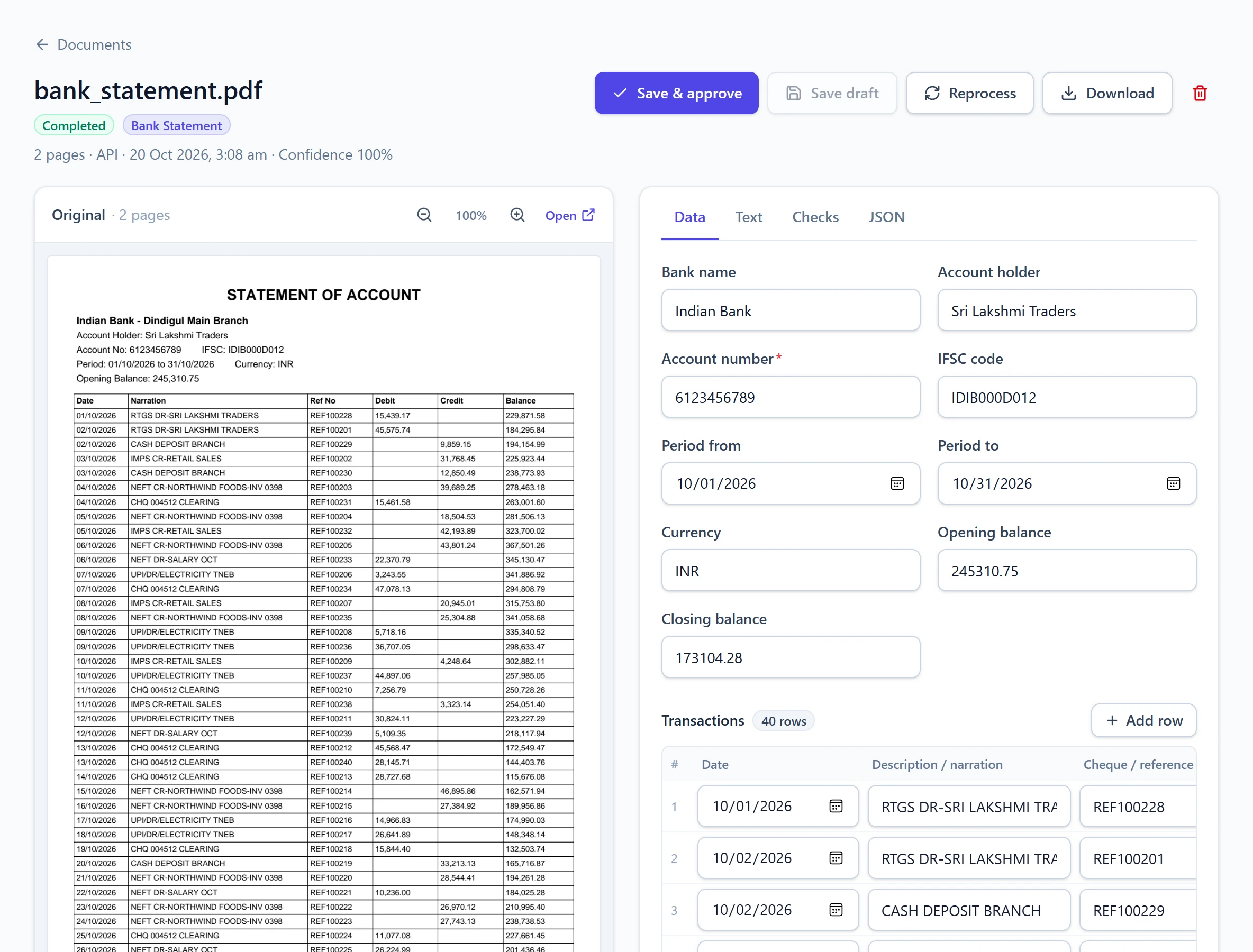
Bank name · Account holder · Account number · IFSC code · Statement period · Currency
Finance & lending
Turn multi-page statements into one table of transactions you can reconcile, analyse or feed to a credit model, with the running balance checked row by row.
01The problem
02Checks
03What you get
Ready to use out of the box. Add, rename or remove fields for your workspace at any time.
Bank name · Account holder · Account number · IFSC code · Statement period · Currency
Opening balance · Closing balance
Date · Description / narration · Cheque or reference number · Debit · Credit · Balance
04In the product
Every value sits next to the original page, every check explains itself, and nothing reaches your systems until it passes or a person approves it.
05Workflow
Tip: send these documents to your workspace address with the .bank alias so they skip auto-detection.
Customers email statements to your bank address, or your system uploads them through the API.
Every transaction row on every page is captured in order, skipping page totals.
Balance checks run automatically; mismatches go to review with the problem highlighted.
Export to Excel or CSV, or receive the transactions as JSON in your own system.
06More solutions
Read supplier GST invoices from email, upload or API and get invoice number, GSTIN, HSN lines and tax totals as Excel, JSON or a webhook.
Read supplier invoices, match them with the purchase order and goods receipt in your ERP, and save them there for review. Only the exceptions reach a person.
Capture purchase orders and goods receipt notes into structured data for three-way matching: PO numbers, items, quantities received, accepted and rejected.
Convert PDFs, scans and photos to clean text with OCR for English, Hindi and Tamil. Upload, email or use the API; download .txt or get JSON.